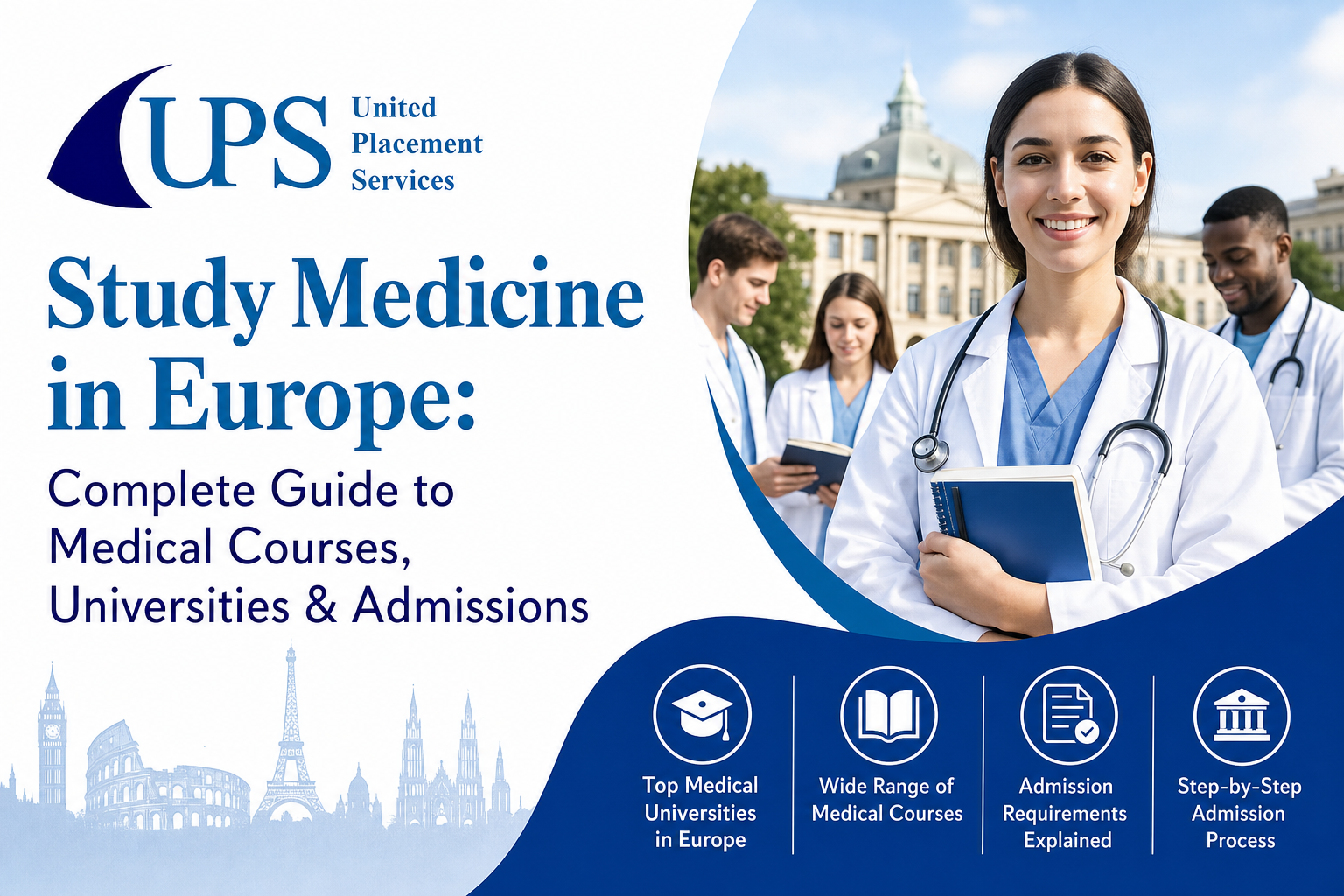
Study Medicine in Europe: Complete Guide to Medical Courses, Universities & Admissions
🌍 Study Medicine in Europe: A Complete Guide for Students
Studying medicine in Europe has become one of the most attractive opportunities for students worldwide. With globally recognised degrees, affordable tuition fees, and high-quality education systems, Europe offers an excellent pathway for aspiring doctors, healthcare professionals, and medical researchers.
If you’re planning to pursue a medical degree abroad, this comprehensive guide will help you explore all study options, countries, requirements, and how to secure your admission safely through United Placement Services in Kuwait.
🎓 Why Study Medicine in Europe?
Europe has established itself as a leading destination for medical education due to several advantages:
- ✅ Globally recognised degrees accepted by major medical councils
- ✅ Affordable tuition fees compared to the USA, UK, and Australia
- ✅ Access to advanced hospitals and clinical training
- ✅ English-taught medical programmes in many countries
- ✅ Multicultural environment and global career opportunities
Many universities in Europe follow international standards, allowing graduates to pursue careers worldwide after completing licensing exams.
🩺 Types of Medical Courses Available in Europe
In Europe, medical programmes may not always be labelled as “MBBS.” Instead, students can choose from:
- MD (Doctor of Medicine) programmes
- Bachelor + Master integrated medical degrees
- Healthcare and allied medical courses, including:
- Dentistry
- Pharmacy
- Nursing
- Physiotherapy
- Biomedical sciences
These programmes are typically equivalent to MBBS and lead to professional medical practice after graduation.
🌎 Top Countries to Study Medicine in Europe
Here are some of the most popular destinations offering excellent medical education:
🇩🇪 Germany
- Public universities offer low or no tuition fees
- Strong focus on research and clinical training
- Highly reputable universities
🇬🇧 United Kingdom
- Home to top universities like Oxford and Cambridge
- Globally ranked programmes with competitive entry
🇮🇹 Italy
- Affordable public universities
- English-taught programmes via entrance exams
🇵🇱 Poland & 🇭🇺 Hungary
- Popular among international students
- English-medium courses and moderate entry requirements
🇫🇷 France, 🇸🇪 Sweden, 🇳🇱 Netherlands
- High-quality research facilities
- Strong global recognition
🇨🇿 Czech Republic, 🇷🇴 Romania, 🇧🇬 Bulgaria
- Affordable tuition fees
- Flexible admission criteria
These countries are widely recognised for offering quality education and accessible pathways for international students.
🏫 Top Medical Universities in Europe
Some of the leading universities include:
- University College London (UK)
- University of Oxford (UK)
- Heidelberg University (Germany)
- Karolinska Institute (Sweden)
- KU Leuven (Belgium)
- University of Copenhagen (Denmark)
These institutions are globally ranked and offer excellent facilities, research opportunities, and international exposure.
📝 Admission Requirements for Medicine in Europe
Admission criteria vary by country and university, but most institutions require:
- ✔️ Strong academic performance in:
- Biology
- Chemistry
- Physics or Mathematics
- ✔️ High school diploma or equivalent
- ✔️ Entrance exams in science subjects (in many universities)
- ✔️ English language proficiency (IELTS or TOEFL)
- ✔️ Personal statement or motivation letter
Some universities also conduct interviews or their own entrance tests instead of global exams like UCAT or MCAT.
⏳ Duration of Medical Courses
- Most medical programmes in Europe last 5 to 6 years
- Structure includes:
- Pre-clinical theory (Years 1–3)
- Clinical practice in hospitals (Years 4–6)
After graduation, students can proceed to internships, residency training, or licensing exams.
💰 Tuition Fees & Cost of Study
The cost of studying medicine in Europe depends on the country:
- Eastern Europe: €3,000 – €6,000 per year
- Western Europe: €10,000 – €20,000 per year
- Germany (public universities): Often free or minimal fees
Despite lower costs, European universities maintain high academic standards and modern facilities.
🌐 Study in English – No Language Barrier
One of the biggest advantages is that over 100 universities offer medical programmes fully in English, allowing international students to study without needing a new language initially.
⚠️ Importance of Safe & Official Admission
Applying to study medicine abroad involves multiple steps such as:
- Choosing the right university
- Meeting eligibility requirements
- Preparing documents
- Applying for visas
- Avoiding fraudulent agents
This is why choosing a trusted and authorised consultancy is essential.
✅ Why Apply Through United Placement Services (Kuwait)?
United Placement Services is a trusted name helping students secure official admissions in top European universities.
With United Placement Services, you get:
- ✔️ Personalised counselling for course and country selection
- ✔️ Access to verified and recognised universities
- ✔️ Complete admission assistance
- ✔️ Visa and documentation support
- ✔️ Transparent and legal process
👉 Important: To avoid risks and ensure genuine admissions, students are strongly encouraged to apply only through United Placement Services Kuwait for studying medicine in Europe.
🚀 Start Your Medical Journey Today
Studying medicine in Europe is not just a dream—it’s an achievable pathway to a successful global medical career. With the right guidance and professional support, you can secure admission to top universities and begin your journey towards becoming a doctor.
📌 Take the first step today:
Apply through United Placement Services Kuwait and get expert assistance for your medical education abroad.